
What is a Tapir?
These rare mammals are often confused with hippos, pigs or anteaters, but their closest living relatives are actually rhinos and horses. Tapirs are a living fossil; they’be been around since the Eocene, having survived waves of extinction of other animals. They are South America’s largest native land mammal, with adults ranging in size from 300-700 pounds.
A tapir’s most notable feature is its unique prehensile nose. Not only can they wiggle their nose, but they can use it to grab leaves when foraging. When swimming, they can use it as a snorkle! They are fast and agile swimmers. Tapir hides are very tough, and their bodies are streamlined for easy maneuvering in the forest. They have four toes on their front feet and three toes on their hind feet, with which they can run very fast for short bursts of speed through the forest.
Tapirs don’t reproduce rapidly like some mammals; their pregnancies are very long – 13 to 14 months! And they only have one baby per pregnancy. Tapir babies stay with their mothers for twelve to 18 months. Though they are tough, resilient animals who have survived for many millennia, as their populations continue to decline, it is increasingly difficult for them to recover.
There are four living species of tapir, each with a distinct appearance and habitat range. Tapirs are found in the forests of Central and South America as well as Southeast Asia. They are becoming rare in their habitats, mostly due to habitat destruction and poaching, and they are designated as either Vulnerable or Endangered as a result.
Learn About Each Species of Tapir:

Lowland Tapir
Tapirus terrestris
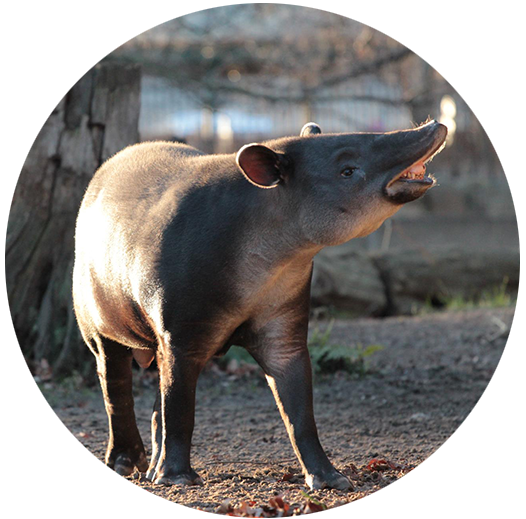
Baird’s Tapir
Tapirus bairdii

Mountain Tapir
Tapirus pinchaque

Malayan Tapir
Tapirus indicus
Tapir Global Range Map
Map by Carlos Pedraza, Tapir Specialist Group, 2008
Threats to Their Survival
Three major threats to the tapir include:
- Being hunted for their meat
- Habitats becoming fragmented due to roads and farming
- Encroachment into protected park areas by subsistence farmers and illegal logging
Tapirs do well where there are few threats impeding their normal needs to thrive in large undisturbed tracts of habitat. Certain areas of the Brazilian Amazon, Brazilian Pantanal, Peruvian Amazon, Honduran Mosquitia and Panamanian Darien forests have healthy tapir populations.
Tapirs in the wild do have predators, typically large cats, though this effect on their population is tiny compared to that of human predation and habitat consumption. Tapir young are born with a beautiful “watermelon” striped pattern on their hide, camouflaging them effectively from predators. Adults are skilled at running through thickets of forest and diving into rivers or deep pools of water to escape predators. Like all herbivores, they serve a role in the ecosystem by being a food source for predators.
Tapirs Play a Critical Role in Their Ecosystems
Tapirs shape and maintain the biodiversity of tropical ecosystems; without them, there would not be the same rich variety of animals and plants there. They are known as an “umbrella species” because they have a wide-ranging habitat that also includes wild cats, monkeys, deer, and many varieties of birds and reptiles. If we protect their habitat, the habitat of many other animals is also protected.
Tapirs are helpful to their native landscape in many ways; one role is that of seed dispersers. Tapirs eat a variety of seasonal fruits; when mango or fig trees come into season, tapirs can often be found underneath these trees, eating the fruits that fall from them, or are dropped by monkeys munching on fruit from above. The seeds of the fruits they eat are dispersed when they wander to a new location to deposit scat, and those seeds later sprout and grow new trees, helping the forest to regenerate. Because of the tapir’s enormous appetite for fruit, they have earned the title “gardeners of the forest.” Forest structure and diversity would be very different without the tapir in the landscape.
Because of their enormous size and large range, the tapir is one of the first species in its habitat to be adversely affected by human disturbance. Local extinction or population decrease may trigger adverse effects in the forest, causing disruptions of some key ecological processes (e.g. seed predation and dispersal, nutrient recycling), and eventually compromising the long-term integrity and biodiversity of the ecosystem. These factors, added to the destruction of tapir habitat in recent years, justify the urgency for investigation of the status of the populations, and development and implementation of conservation and management plans.
Tapir Specialist Group advocates on behalf of tapirs and works to conserve their habitat and genetic diversity through research projects on tapirs, high standards of zoo husbandry, and networking with government bodies, conservation organizations, universities and zoos to create greater tapir awareness and conservation planning.
Learn More
The International Union for Conservation of Nature (IUCN) maintains the Red List, widely recognized as the most comprehensive and objective global database of the conservation status of plant and animal species.

